

Tuesday, January 3, 2012
Wretched Excess
This one appeared as the back cover of Fantagraphics' Zero Zero. Mid '90s, but I don't remember the exact year, only that 100 MB was considered to be a lot of memory back then. So to bring this up to date you'd have to include cell phones (20); digital devices (50); DVDs (1000); I forgot Sports Memorabilia (100 lbs.). I'm sure there's other stuff I've forgotten, but memory--the biological variety--is maxed out.


Sunday, December 25, 2011
A Seasonal Post
This one appeared in The New Yorker magazine, Winter, '94. I was with my late brother Keith in a Village cafe in mid-December. He introduced me as to the waiter as "a cartoonist for The New Yorker" though I had only a couple things published in the magazine then. A elegant old dame sitting a few tables away introduced herself and said to me, "I've always wanted to see Zeus hurling lightning bolts at Santa, saying 'Tis my season!'" I had another idea sketched-out that I was going to submit later in the morning, so as a complete crapshoot I did this the rough for this one in a cab uptown. The lowercase gods were with me then. These days I could use a favor from Jove, though I could do without the bloodletting, barbarism (Jerry Sandusky would have been a normative Roman), lack of plumbing and superstition. Happy Holidays To All!


Sunday, November 27, 2011
Thoughts About Weed
This strip was published in Heavy Metal when Mark Martin was the cartoon editor. Let’s see…66 minus 48 is 18. My long relationship with cannabis went through yet more twists and turns after this strip was done (in addition to the 48 minus 28 years prior) before I arrived to this irrevocable position to put it down for good. After a brief psychic and physical struggle for a season or two, I finally got past the yen to toke. I don’t want to miss a moment of real life! (continued under strip...)
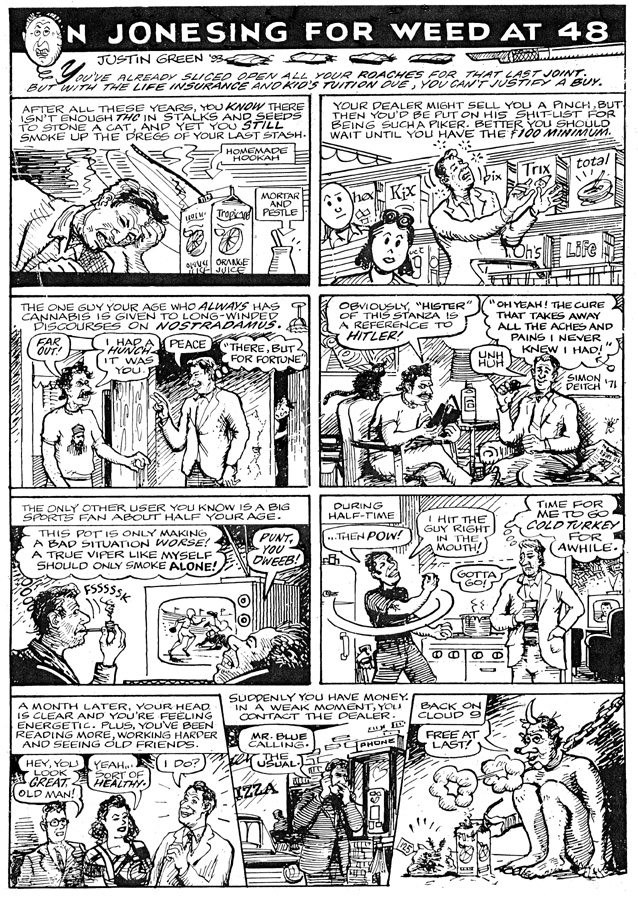
somebody refer to weed as “The Buddha.” It’s anything but. Cannabis Sativa (or Indica for the more jaded) is a cruel dominatrix who exacts a heavy toll for all the so-called gifts she bestows.
somebody refer to weed as “The Buddha.” It’s anything but. Cannabis Sativa (or Indica for the more jaded) is a cruel dominatrix who exacts a heavy toll for all the so-called gifts she bestows.
These days, unless you’re growing it yourself, chances are high that the stuff has Mexican blood on it. I’m also not buying the concept that this addictive drug is an herb—the more often you get high, the more you want to stay that way and you’ll need stronger and more expensive shit to stay there, period. The health risks are tangible: increased susceptibility to oral and throat cancer; the spleen function is impaired; memory function is blighted; worst of all, if you are combining weed with tobacco use, your chances of contracting lung cancer are increased fourfold. Why do you think the cartoonist Dave Sheridan died in his mid ‘30s and the great Nat King Cole died in his mid ‘40s? “Medical” marijuana for anyone but the terminally ill? See final paragraph.
If you are an artist or musician and weed is part of your muse process, you won’t have the sustaining stamina needed for the long haul. If you smoke several times a day, get it down just once; if several times a week, then one day. If several times monthly, then make it weekly. Or go cold turkey, little sapling. Failing that, try the real Buddha. On the other hand, if you are one of those rare and lucky people who can take it or leave it and your sole source of attaining a pot high is through occasional joints at parties or gifts from friends, more power to you. Still, beware. Few people who are able to truly appreciate a marijuana high can leave it alone for long. That smoky plateau is an egocentric, selfish state of mind that makes you less empathetic to your loved ones, though you keep trying to tell yourself that it’s bringing you closer. What little comforts are you denying them for the continuation of your expensive and stinking habit?
It also makes you vulnerable, dulling the adrenaline you need for sheer survival. You must be able to trust your intuition at all times. Wake up! You still have the rest of your life to muddle through, knowing that you’re closer to a clarity and inner peace far more beautiful than all of those pipe dreams could ever have provided.
Despite all of the above, I’m for legalization—if only to stop the violence in Mexico and the end of this disgusting “Medical Marijuana” movement. I don’t want to see anybody behind bars for dealing or using. The heavy toll on the individual and society by perfectly legal alcohol is far more serious. On the other hand, buzzed driving is drunk driving—and mandatory blood/saliva tests should be taken at all accident sites. There, I have spoken.
Monday, October 24, 2011
An Offer You Can't Refuse

Like many who suddenly become Seniors, I turn to the great literature and movies of my youth as reference points to gain a better foothold on this shifting dirt of mortality. To note the passing of an earlier age I hereby conjure up the voice of Upton Sinclair in his 1909 muckraking classic “The Jungle.” And why not? The internet is a vast Babel where History is yours for the ransacking. You, too, can be another pulsing frequency with a few deft mouse clicks.
In addition to the heartrending and thoroughly accurate accounts of slaughterhouse working conditions informed from undercover experience, Sinclair describes how economic blight and deprivation impact cultural standards. Within the immigrant Polish community in which many Chicago meat workers lived there was an Old World tradition that wedding guests compensated newlyweds for their lavish feast with gifts of money or high value items. Yet in America many invited revelers were living on the brink of survival, so the wedding banquet was only a temporary reprieve from starvation. These destitute guests had neither the means nor the inclination to contribute anything besides big appetites to the celebration. After the feast, before the customary time for toasts and presentation of gifts, some disreputable diners would exit out the banquet hall windows and jump to the street below. The hapless bride and groom would be ruined even before their first wedding night.
Bear with me. The drawing you see above was sent to Michael Wilde in ’96 (thanks to him for taking a digital shot recently). Not so long ago it was common for artists to embellish their letters and envelopes with quick sketches and doodles. Of course, correspondence has changed for the obvious reasons—the immediacy of the phone, social networking and email has made the slower exchange of ideas seem quaint. Yet these modern modes prod like alarm clocks. A well-conceived piece of writing demands rumination. There is an assumption that failure to respond immediately is some kind of lapse. But some ideas and emotions need to be absorbed before they are met in a worthy response. Part of the writing process entails showering these received ideas with attention and letting the field of present experience gradually illuminate them. Doodling and sketching are a way to get in the writing zone, or to compliment words that have been set down--and a well designed envelope is always a pleasure to receive. Some artists, most notably S. Clay Wilson, use embellished correspondence as a warm-up exercise.
Back to “The Jungle.” Though we aren’t (yet) reduced to handling cattle carcasses, most of us are struggling just to stay afloat. There are few, if any, positive predictions on the shape of things to come in the world economy. As an Icelandic wag remarked after the crash of Nokia, “We are all turning to porridge.” To step outside of the survival realm and to pretend that we are men of ideas with an innate need to communicate at the soul level is a neat trick for a cash-strapped man to perform. So when a friend or reader takes the time to imbue life with meaning via a personal contact—a feast that is shared with no other--it’s not uncommon for the recipient of that gift to jump out of the window like a sneaky Stockyards wedding guest by firing off a breezy email or simply not responding at all. Whether this is a personal failure or a savvy way to stay alive is not my judgment call to make. Only a wedding-leaper knows his true motives. But the lapse in substantive response is definitely a trend—and Facebook, tweeting, blogging, etc. don’t qualify as earnest personal communication. The obvious virtues of these social media are speed, mass replication and glitzy form; content is still dependent on old-fashioned individual consciousness.
Re: the drawing above. This is apparently a non-negotiable deal. Once you’ve made that bargain, it’s Tip-Taps, No Trade-Backs. But if I could somehow do it again, I’d exchange my Immortal Soul for Eternal Peace.
Tuesday, September 27, 2011
Thanx And A Tip O' The Hat to Jimmy Hatlo
Cartoonist Jimmy Hatlo’s prolific output spanned over four decades. He is known mostly for “There Oughta Be A Law,” a single panel syndicated strip which ran from 1929 until his death in 1963. His densely drawn imagery and highly nuanced writing thrived at the generous scale at which newspaper comics were then printed. Reading Hatlo is also a fascinating study to the forgotten American social conventions, fads and fashions.


Scroll under images to continue article...


His subject matter covered a breadth of topics unparalleled in the field (okay, maybe Ripley ran a close second but he wasn’t funny) because he solicited ideas from his millions of readers. It now seems quaint that the names and actual addresses of contributors were printed with each strip. That was before the era of financial institutions and/or sociopaths benefiting from knowledge of one’s personal information. Readers from every walk of life shared their unique insights about the foibles of humanity via the concrete details of those trades and disciplines in which they were steeped. He must have had quite a “morgue”. Before easy Internet fingertip access to any image, most professional cartoonists had filing cabinets full of photos and illustrations that could be summoned whenever the need arose. Any foreign object vital to conveying a gag idea would become uniquely Hatlo-ized, as if he effortlessly conjured it up with a few deft strokes. His pristine and often bold ink lines bring his subject matter to life with a directness and clarity.
As anyone who has attempted to draw a crowd scene in which specific details and objects need to be crystal-clear, can attest, this is not so easy to do! While the laws of perspective are generally obeyed, Hatlo is just as engaged in the two-dimensional arrangement of people and objects situated in specific landscapes or interiors. There is so much visual information to be conveyed—along with tightly packed word balloons—the overall composition is a daunting juggling act. But Hatlo always magically manages to pull this off. Background characters are not given short shrift as most cartoonists, even good ones, do. His drawing is so great we don’t think about it.
The masterfully lettered dialog balloons range in content from pithy to hilarious. They are mostly corollaries of the main punchline, though sometimes they’re superior. This lush verbiage could hold its own with cinematic script writing. But Hatlo had no pretensions to making higher art. He was a champion of the common man’s art form. Hatlo was an advocate for the underdog, always sympathizing with workers over their bosses and wives over husbands (with the occasional exception) and those who suffered at the expense of others’ pretensions or just plain bad luck. I have no doubt that you could score one of his old volumes for a song on Amazon. Any serious cartoonist needs to have a little Hatlo on his or her shelf. I was amazed to discover he also had a running script called "The Hatlo Inferno." Google the title and you'll find a modern version available. You may also remember the character Little Iodine. Once part of his stable of stock characters, she jumped out to her own showcase. No Shirley Temple, she, but smart as a whip.
There was an imitation of Hatlo’s “There Oughta Be A Law,” which ran in the Chicago Tribune called, “They’ll Do It Every Time,” by Al Fagaly and Harry Shorten. I am delighted that they attributed a cartoon to Yours Truly when I was 13, though it was not the one I sent in. Over “Thanks to Justin Green of Highland Park, Ill.” was a strip about a guy who never took the newspaper that was on top of the pile (“Thaddeus Bop wouldn’t dream of taking the one that’s on top!) May father was finally delighted by something that I had supposedly done, and mimeographed copies were sent to all the relatives and business contacts. It seems fitting that my cartooning career began with a lie. For almost 40 years, the common perception of me which I can’t seem to shake is that I'm "The Underground Cartoonist Justin Green who produced ‘Binky Brown Meets The Holy Virgin Mary.’” The work I’m doing now is my best work and Catholic Guilt is just one jar on my spice rack. It is such an irony that anything signed by me from the early ‘70s fetches roughly ten times the amount that my far more accomplished work does today. Only Hatlo could do justice to this inequity. “Justin Green turns the color of his name when he sees stuff he did as a kid fetching big bucks, while in his Golden Years he has to paint signs to stay afloat.” Yeah, that would make a great Hatlo panel.
Sunday, September 11, 2011
Please Visit My Other Cartoon Site
Earlier this year I launched a new site with my fellow penman Brian Hagen. You could beam us up at http://www.pengrenades com
This is the current post. If you click on my archives button there, you'll see my latest work.

This is the current post. If you click on my archives button there, you'll see my latest work.

Thursday, August 25, 2011
Early '90s Politics

This piece appeared in a Sacramento newspaper back when restaurants were dealing with the newly discovered health issue of toxic tobacco air by cordoning off Smoking Areas just a few yards away from where normal human beings dined. The cartoon may seem obvious by today’s standards, but back then it was a shot fired across the bow at pro-tobacco advocates who wanted a more civil discourse about their habit.
This cartoon is also time-warped for the use of Zip-A-Tone. Transparent sheets of dots in various weights created tones of gray. The #11 Xacto blade was wielded on the flimsy and finicky material to cut the elaborate shapes that were required. Though once the staple of most professional illustrators and cartoonists, this product (along with rub-down letters) became suddenly obsolete as the computer set the new standards of reproduction.
This artwork is now offered on Ebay, until 9/4 Here’s the link (to paste in browser with rubber cement):http://www.ebay.com/itm/250880685321?ssPageName=STRK:MESELX:IT&_trksid=p3984.m1555.l2649
Subscribe to:
Posts (Atom)